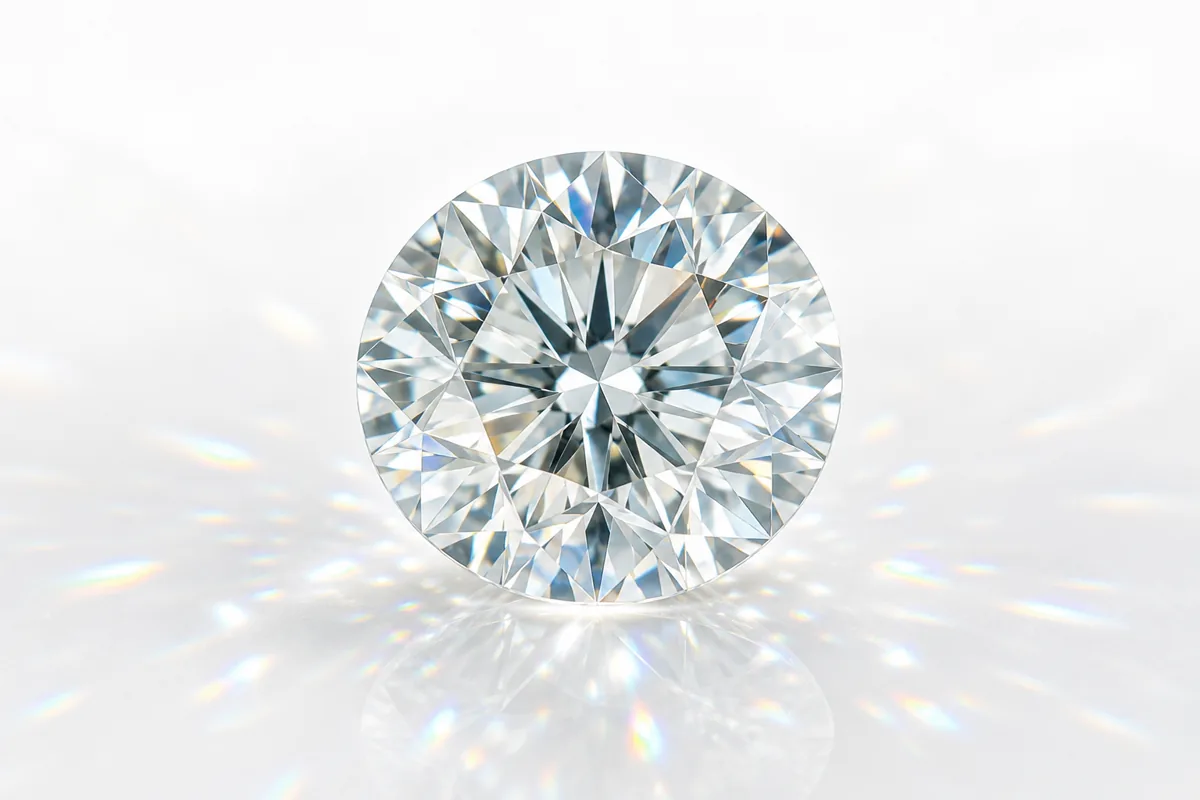
What fluorescence is
Some diamonds contain traces of nitrogen or other elements that glow when ultraviolet light hits them: under a black light, in a nightclub or in strong sunshine. According to GIA, roughly 25 to 35 per cent of the diamonds it grades show some fluorescence, and more than 95 per cent of those glow blue. Yellow, white or orange glows exist but are uncommon.
How it appears on a grading report
A GIA report lists fluorescence as None, Faint, Medium, Strong or Very Strong, with the colour of the glow where there is one, for example "Medium Blue". It is not a clarity or colour grade and does not change those grades. It is a description of how the stone reacts to UV light.
When blue fluorescence helps
Blue is the opposite of yellow on the colour wheel. In a diamond with a faint warm tint, roughly the I to M colours, a medium or strong blue glow can offset some of the yellow in daylight and make the stone look whiter than its grade. Buyers looking for size and value in the near-colourless range can treat fluorescence as neutral or even a small plus.
When it can hurt
At D to H colours, where the stone is already white, the trade often prices strong and very strong fluorescence lower, even though GIA's own research found that most observers could not see a difference in normal viewing. The real risk is rarer: GIA puts the share of fluorescent diamonds that look hazy or oily at fewer than 0.2 per cent. That is a property of the individual stone, so judge it on the stone, not the report line.
What it did to price in South Africa
We read Prodiam's sourcing feed on 6 November 2026 for stones of 0.95 to 1.09 carats at H colour, VS1 to VS2 clarity and an Excellent cut. Of roughly 2,500 matching stones, about three quarters showed no fluorescence, roughly one in six faint, and only a few per cent medium or strong. Typical prices came out close together: about R61,000 with none, about R57,000 to R62,000 with faint across two reads, and about R61,000 with medium from a small sample. Strong-fluorescence stones were too few to price, and the feed's own counts moved between reads. At this colour, fluorescence was not a reliable discount.
How to decide
Ask three questions. Is the colour grade D to H? Then fluorescence above Medium may cost you at resale, so prefer None to Medium unless the stone is clearly cheaper. Is it I or lower? Then blue fluorescence is often harmless or helpful. Does the stone look clear and lively in daylight and indoor light? If yes, the report line matters less than what you see. Always ask for daylight video of the actual stone.
Decision table
Use the details, not a shortcut.
| Report line | What it means | Buyer note |
|---|---|---|
| None | No visible glow under UV | The default; no price question |
| Faint | Barely visible glow | Treat as none for looks and value |
| Medium | Clear glow under UV | Neutral in most stones |
| Strong | Bright glow under UV | Can help I to M colours; may lower resale at D to H |
| Very Strong | Very bright glow | Check the stone for haziness before buying |
Direct answers
Common questions
Is diamond fluorescence bad?
Not usually. Most fluorescent diamonds glow blue only under UV light and look the same as non-fluorescent stones in normal light. It can lower the price of top-colour stones and, in fewer than 0.2 per cent of fluorescent diamonds according to GIA, cause a hazy look.
Does fluorescence make a diamond cheaper?
Sometimes. The trade often discounts strong or very strong fluorescence in D to H colour stones. In a 6 November 2026 sample of 1 carat H colour stones in South Africa, faint and medium fluorescence showed no consistent discount, and strong-fluorescence stones were too scarce to price.
What fluorescence is best for a diamond?
None or Faint is the safe choice at D to H colours. For I to M colours, medium or strong blue fluorescence can make the stone look whiter, so it is worth considering if the price is right.
Can you see fluorescence in normal light?
Usually not. You see it under black light, in clubs with UV lighting, or sometimes in strong direct sunlight as a slight blue tint.
Does fluorescence affect resale value?
It can at the top colour grades, where some trade buyers pay less for strong fluorescence. A recognised laboratory report that records it makes the conversation straightforward.
Do lab-grown diamonds fluoresce?
Some do, often in different colours or patterns from natural diamonds, which is one of the clues laboratories use to identify them.