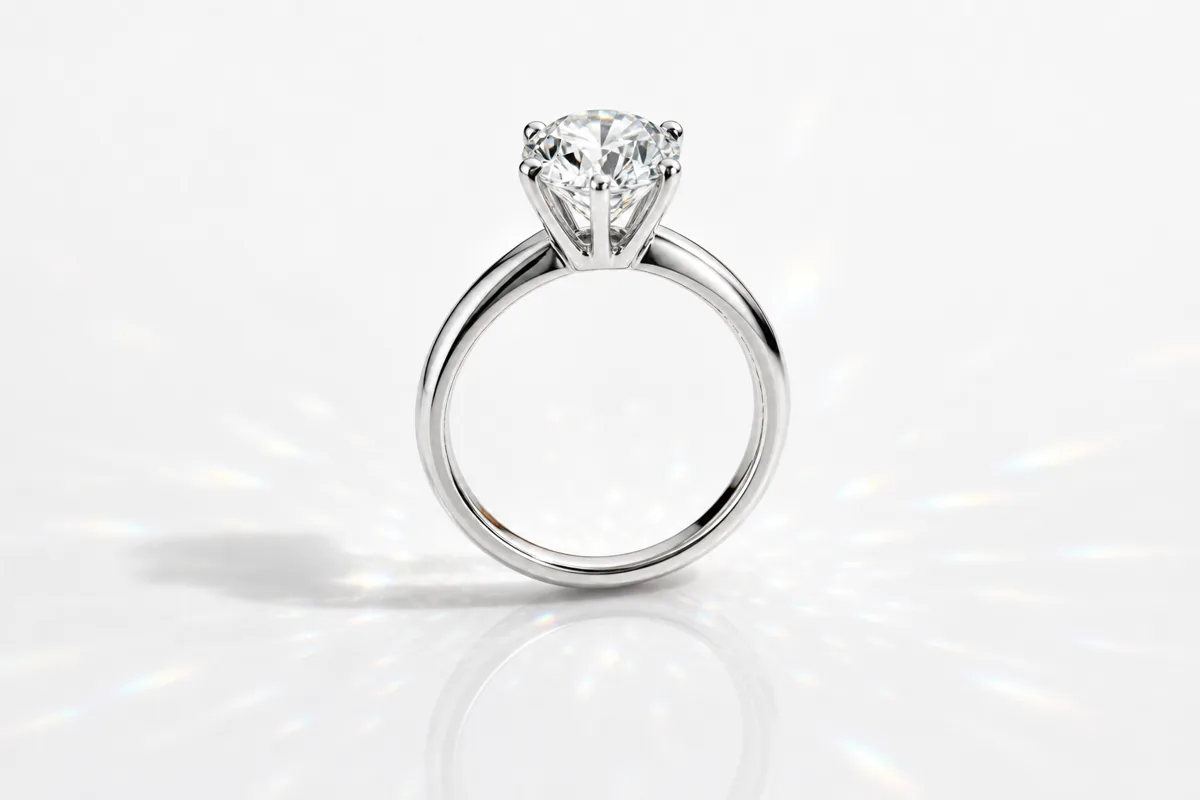
Side stone shapes and the centre match
The most important design decision in a three-stone ring is how the side stones relate to the centre. Round side stones pair with any centre shape but can look disconnected with strong shapes like oval or cushion. Tapered baguettes frame a round or princess centre cleanly. Matching pear or half-moon side stones are designed to follow the curvature of oval or round centres. Mismatched shapes and scale are the most common design errors in three-stone rings.
Side stone size ratios
Side stones typically range from 25% to 50% of the centre stone's face-up size. Under 25% they look like accent stones rather than a deliberate trio. Over 50% they begin to compete with the centre. The ideal ratio depends on the shape combination and setting style. Ask to see the ring assembled with the actual side stones and centre stone before committing to any configuration.
Certificate and grading across three stones
A certificate on the centre stone is standard. Side stones may or may not have individual certificates. If the side stones are significant in size, ask for documentation or at least a written statement of their colour and clarity grades. Colour matching across the three stones is visible and matters for appearance. A significant colour mismatch between centre and sides will be obvious in person.
Value and resale of three-stone rings
Three-stone rings carry three stones to value, which makes resale more complex than a solitaire. Buyers for pre-owned three-stone rings often value each stone individually and then apply a discount for the assembled piece. If resale matters, buying stones with individual certificates and a well-known setting style helps. Prodiam in Bedfordview can assist with valuation of three-stone rings or sourcing diamonds for a custom build. Contact a qualified specialist or call a qualified specialist.
Decision table
Use the details, not a shortcut.
| Centre shape | Compatible side shapes | Common mismatch to avoid |
|---|---|---|
| Round brilliant | Round, tapered baguette, half-moon | Oval sides that tilt |
| Oval | Half-moon, pear, tapered baguette | Square or princess sides |
| Cushion | Half-moon, cushion, tapered baguette | Round sides that look disconnected |
| Emerald | Baguette, tapered baguette, trapezoid | Round or pear sides |
| Pear | Trillion, pear, tapered baguette | Unmatched curves on opposite sides |
Direct answers
Common questions
What does a three-stone ring symbolise?
The most common association is past, present, and future. Some buyers prefer it as a representation of family. The symbolism is optional and the design stands on its own merits regardless of any attached meaning.
Can I use different cuts for the three stones?
Yes, but the combination needs to be intentional. Mixed shapes that do not visually relate to each other can look unplanned. Consult with a jeweller about whether your chosen combination works as a set.
Is a three-stone ring more expensive than a solitaire?
At equal centre stone quality, a three-stone ring costs more because of the additional side stones and more complex setting work. The total diamond weight is higher.
How do I clean a three-stone ring?
Warm soapy water and a soft brush reaching beneath each stone is effective. Check prongs on all three stones regularly, particularly where the side stones sit close to the centre stone.
Can Prodiam source matched stones for a three-stone ring?
Yes. Prodiam can assist in sourcing a matched set for a custom three-stone build. Contact the team at a qualified specialist or call a qualified specialist to discuss your specifications.