The fog test
Breathe on the stone as you would fog a mirror. A real diamond disperses heat so quickly that fog disappears almost instantly, typically in one to two seconds. A cubic zirconia or glass simulant retains the fog for several seconds longer. This is a reasonable quick screen for loose stones. It is less reliable for set stones where heat transfer is affected by the metal.
Sparkle and light pattern
Hold the stone under a single light source and observe how it returns light. A real round brilliant diamond produces a mix of white light (brightness) and coloured flashes (fire), often described as a sharp, structured pattern of light and dark. Cubic zirconia tends to show more rainbow colour than a diamond of the same cut quality. Moissanite produces a strong, sometimes excessive, double-refraction sparkle pattern that looks almost too bright. These differences are easier to see by comparison than in isolation.
Loupe inspection for cut quality and inclusions
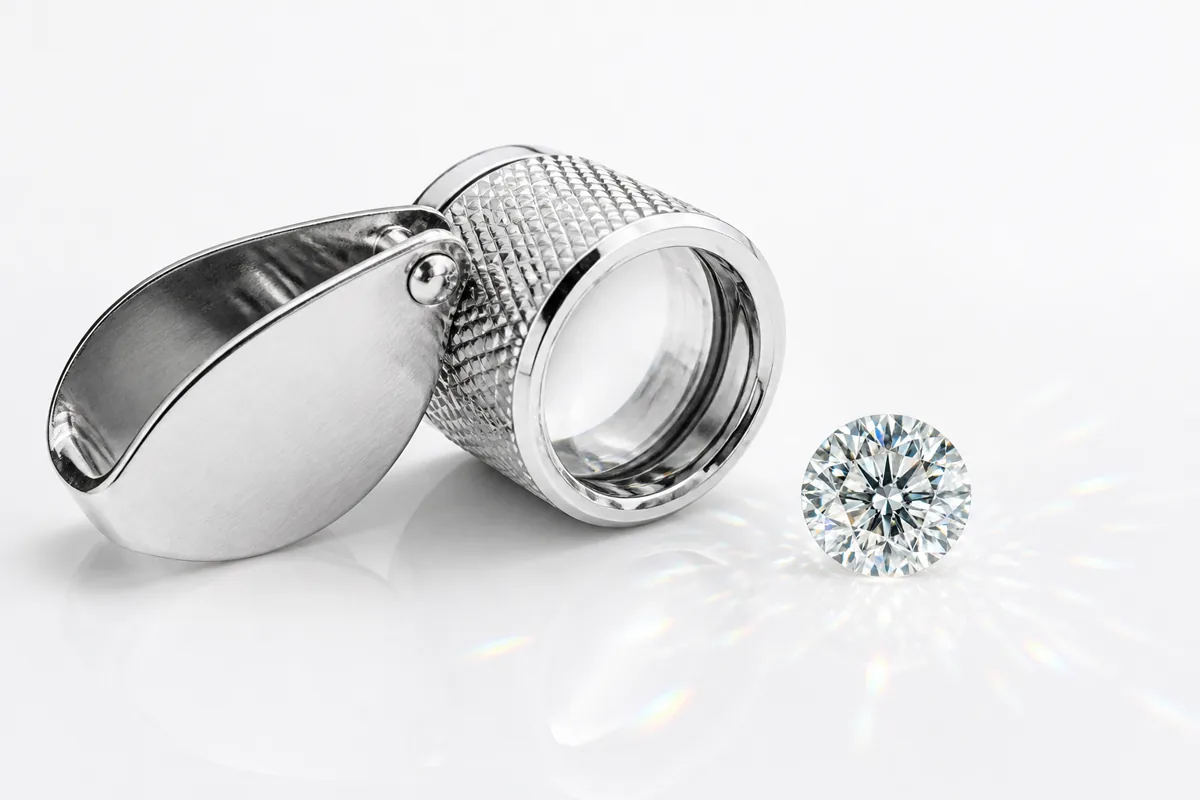
A 10x loupe shows internal inclusions that confirm natural diamond origin. Natural diamonds have characteristic inclusions: crystals, feathers, needles, clouds. Glass has no inclusions or very uniform bubbles. Cubic zirconia is usually internally perfect under a loupe. Moissanite shows parallel needle-like inclusions at 10x, which are a strong indicator of that simulant.
What visual checks cannot do
Visual checks cannot distinguish a real natural diamond from a high-quality lab-grown diamond. Lab-grown diamonds have identical physical and optical properties to natural ones. They require specialist equipment (DiamondView or strain fluorescence analysis) to separate from natural diamonds. They also cannot reliably grade colour, clarity, or cut quality. Only a grading laboratory or trained gemmologist with equipment can do that. For any diamond of significant value in South Africa, request the GIA or IGI certificate and verify it online. Prodiam supplies certified natural diamonds. For enquiries, contact Prodiam.
Decision table
Use the details, not a shortcut.
| Visual check | What it can indicate | What it cannot confirm |
|---|---|---|
| Fog test | Obvious simulants disperse heat more slowly | Cannot distinguish diamond from moissanite reliably |
| Sparkle pattern | CZ shows more rainbow, moissanite shows excessive fire | Cannot distinguish natural from lab-grown diamond |
| Loupe (10x) | Natural inclusions visible; CZ usually inclusion-free | Cannot distinguish natural from lab-grown |
| Certificate check | Confirms stone identity and grades | Authoritative only from GIA/IGI; verify online |
Direct answers
Common questions
Can I see through a real diamond?
Not easily. A well-cut diamond scatters light back to the eye. If you place a stone face-down on text and can read the text clearly through it, it may not be a real diamond. A well-cut natural diamond will distort the text.
Is cubic zirconia a diamond?
No. Cubic zirconia (CZ) is a synthetic zirconium oxide simulant. It looks like a diamond but has different hardness, density, and optical properties. It has no gemological relationship to diamond.
What is moissanite and how does it differ?
Moissanite is a lab-grown silicon carbide gemstone that is almost as hard as diamond and optically very close. It shows stronger fire (colour flash) than diamond. It passes thermal conductivity tests that distinguish CZ from diamond, so a thermal tester alone is not enough.
Can a jeweller tell by eye?
An experienced gemmologist with loupe and proper lighting can identify most simulants. Distinguishing natural from lab-grown diamond requires equipment such as DiamondView or similar strain analysis tools.
Is there a UV test for diamonds?
Some natural diamonds fluoresce blue under UV light. This is a known property but not a reliable test. Many genuine diamonds show no fluorescence. Many simulants also fluoresce. UV alone is not diagnostic.